


The Current Procedural Terminology (CPT) helps to facilitate communication between patient, healthcare provider and insurance company regarding billing and record keeping. 50 years back in 1966, AMA created CPT codes that have become the most popular tool to code bills in the medical field in the United States.
While CPT codes contain more than 10,000 various numbers, the constant usage rates are done by over a thousand numbers. Medical billing errors run to $68 billion annually in the United States, hence the significance of accurate CPT codes. Lab CPT codes help to define individual laboratory procedures. It also means that the healthcare workers and insurance firms carry out their paperwork, bills, etc. and all of these save time and costs leading to higher lab service reimbursements.
Lab CPT codes are essential for effective and accurate medical billing and record-keeping, as we’ll discuss in this blog. We’ll explain lab CPT codes, how they categorize and streamline laboratory tests, and why healthcare providers and insurance companies need them. Understanding lab CPT codes helps simplify medical billing for providers, patients, and billers.
What Are Lab CPT Codes?
Lab CPT codes are as a result specific to laboratory services. These codes refer to blood tests, pathology tests and other samples necessary to diagnose a patient’s overall health. Lab CPT codes make billing and patient records accurate.
The following codes keep billing complications away, and set down legitimate charges and full records in general healthcare practices. These standardized codes assist healthcare practitioners in avoiding the errors often caused by billing issues, discourage denials of charges, and maintain full records in healthcare practices for quality medical practices.
Why lab CPT codes matter in medical billing
Laboratory claims depend heavily on accuracy. Unlike some other areas of billing, lab services often involve high volumes, narrow coding distinctions, and payer-specific coverage rules. That means even a routine claim can run into trouble if the code selection is off.
When lab CPT codes are used correctly, they help streamline billing in several ways:
- They improve claim clarity by identifying the exact laboratory service performed
- They support faster claim adjudication by giving payers standardized billing language
- They reduce preventable denials caused by vague or mismatched reporting
- They strengthen internal documentation and compliance practices
- They help practices track reimbursement more accurately across lab-related services
A clean claim starts with correct coding. If the code does not align with the test performed or the documentation in the record, reimbursement can stall before it starts.
If your team is spending too much time correcting denials, checking payer rules, or sorting through confusion around lab CPT codes, Resilient MBS can help bring structure to the process. We help healthcare organizations improve coding accuracy, reduce billing delays, and build cleaner workflows for laboratory claims.
Common CPT Codes for Laboratory Services
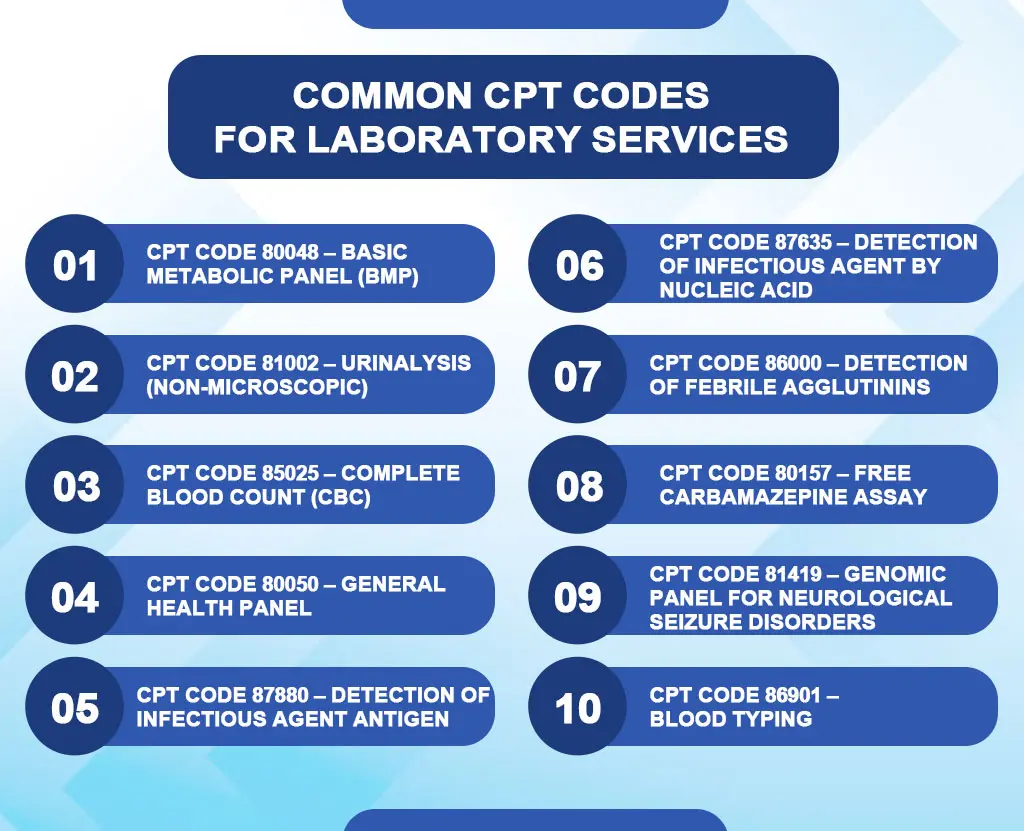
Here is a summary of frequently used CPT codes for laboratory services:
CPT Code 80048 – Basic Metabolic Panel (BMP)
This code applies when a BMP test is ordered, typically in emergencies, to provide essential information on a patient’s metabolism and kidney function.
This code measures eight specific blood chemicals: creatinine, sodium, calcium, chloride, potassium, carbon dioxide, blood urea nitrogen, and glucose.
CPT Code 81002 – Urinalysis (Non-Microscopic)
Used for various screenings, including pre-surgical evaluations, pregnancy, or routine exams, this code represents a urinalysis test without microscopic examination.
A urine sample is collected, and the lab analyst uses a dipstick or reagent tablet to obtain results within a set time. No microscopic analysis is involved.
CPT Code 85025 – Complete Blood Count (CBC)
This CPT code is used for a CBC test, which is useful for identifying conditions like anemia or detecting significant drops in white blood cells, potentially indicating infections like dengue.
A blood sample is taken and stored in a tube with anticoagulants. Automated analyzers then quantify different blood cell types.
CPT Code 80050 – General Health Panel
This CPT code is used for a general health panel with a specific clinical test set. It should be billed only if the provider explicitly requests a comprehensive health screening, as using it for diagnostic component tests may lead to claim rejections.
CPT Code 87880 – Detection of Infectious Agent Antigen
This code is used for rapid antigen testing to detect infectious agents in a patient sample, such as group A Streptococcus, usually from a throat swab. It allows for a quick diagnosis of certain infections.
CPT Code 87635 – Detection of Infectious Agent by Nucleic Acid
Similar to code 87880, this code uses a nucleic acid amplification method to detect infectious agents like SARS-CoV-2. Widely used during the COVID-19 pandemic, it remains relevant for detecting viral infections.
CPT Code 86000 – Detection of Febrile Agglutinins
This code represents qualitative or semiquantitative immunoassays for febrile agglutinins in blood, useful for diagnosing illnesses like Q fever, typhus, or brucellosis.
CPT Code 80157 – Free Carbamazepine Assay
This test measures free (unbound) carbamazepine levels in the blood, often used to monitor medication levels for psychiatric or neurological conditions like epilepsy.
CPT Code 81419 – Genomic Panel for Neurological Seizure Disorders
This code is used for a genomic sequencing panel that analyzes at least 24 genes to assess genetic risk factors for epilepsy and related neurological seizure disorders.
CPT Code 86901 – Blood Typing
Found within transfusion medicine, this code covers blood typing for the Rh blood group, typically using serum plasma as the sample.
Lab Code vs. CPT Code: What’s the Difference?
Lab codes and CPT codes are important in medical billing and coding, although they are utilized differently. Laboratory codes identify each test or treatment performed in a lab. They expedite lab, healthcare provider, and insurance company communication to standardize test codes for invoicing and record-keeping.
In contrast, CPT codes cover a wider range of medical treatments, including diagnostic, therapeutic, and surgical procedures. CPT codes, developed by the American Medical Association (AMA), standardize healthcare billing across specializations and facilities. Complex lab tests may employ CPT codes, whereas lab codes are particular to individual tests.
It is very important to know the difference between lab and CPT codes for correct billing and compliance, as using the wrong code can cause insurance claims to be delayed or denied. CPT codes cover a lot of different services, but lab codes are special to the lab. Choosing the right code is very important for making sure that billing rules are followed.
The Role of CPT Code Lab Review in Medical Billing
Coding a lab service correctly the first time is important. Reviewing it before submission is just as important.
A strong lab CPT code review process helps catch issues such as:
- Codes that do not match the service performed
- Panel codes used incorrectly
- Missing or incomplete documentation
- Payer-specific conflicts that could trigger denials
- Unclear links between test orders and billed services
This review step protects both compliance and revenue. Without it, practices may not realize there is a problem until claims start coming back unpaid.
For billing teams handling high claim volumes, even a small improvement in coding accuracy can create a noticeable difference in reimbursement speed and denial rates.
Why accurate lab CPT coding improves reimbursement
Payers do not reimburse based on assumptions. They reimburse based on what is documented, coded, and supported in the claim.
When lab CPT codes are accurate, healthcare organizations have a better chance of:
- Getting paid faster
- Reducing back-and-forth with payers
- Avoiding unnecessary rework
- Maintaining cleaner audit trails
- Improving overall revenue cycle performance
That is especially important in laboratory billing, where the volume of repetitive services can magnify even small mistakes. A single recurring coding issue can quietly affect dozens or hundreds of claims over time.
Best practices for using lab CPT codes effectively
Practices do not need a complicated strategy to improve lab coding. They need a consistent one.
Start with current coding references. Old cheat sheets and outdated billing habits are one of the fastest ways to create avoidable denials.
Next, make sure clinical documentation supports the billed test. If the record is vague, incomplete, or inconsistent with the code, the claim becomes vulnerable.
It also helps to monitor denial patterns regularly. If the same lab services keep getting delayed or rejected, the cause is often tied to code selection, documentation gaps, or payer-specific requirements.
The goal is simple: cleaner claims submitted with fewer preventable mistakes.
Final thoughts
Understanding lab CPT codes is essential for anyone involved in laboratory billing. These codes do more than describe a test. They support claim accuracy, improve communication with payers, strengthen documentation, and help organizations protect reimbursement.
When coding is handled well, the entire billing process becomes more efficient. Claims move faster, denials become easier to prevent, and staff spend less time fixing problems that could have been avoided at the start.