
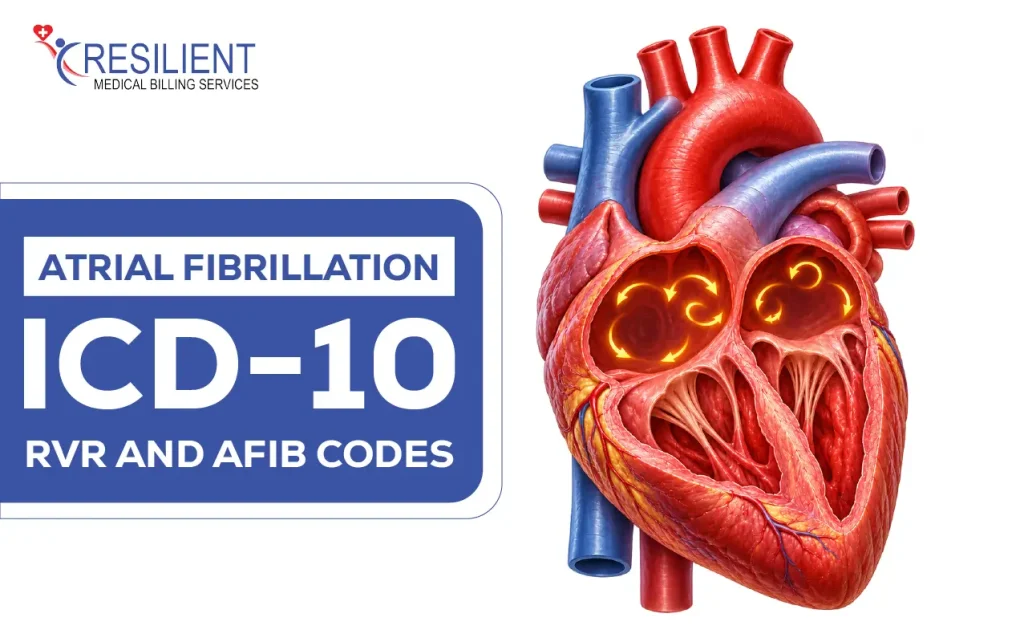
Atrial Fibrillation ICD 10: Choose the Right I48 Code
The ICD-10 code for atrial fibrillation (AFib) is I48.91, when the type of AFib is not specified. I48.0 is used to code paroxysmal atrial fibrillation (atrial fibrillation of a brief nature and duration), I48.11 to code long-standing atrial fibrillation (atrial fibrillation of a persistent nature that has persisted for at least 12 months), I48.19 to code other atrial fibrillation (of a persistent nature that has persisted for at least 12 months, and is of an unspecified duration), I48.20 to code chronic atrial fibrillation (of an unspecified duration), and I48.21 to code permanent atrial fibrillation. These codes are contained in I48, which also includes atrial flutter.
The difficult cases in this chapter include rapid ventricular rates (tachycardia) with no clear diagnosis, conflicting diagnosis (such as AFib vs atrial flutter), sinus rhythm (not atrial fibrillation), and unclear treatment status. Codes are selected based on the case documented, and documentation is justified for payment.
Atrial Fibrillation ICD 10 Code Table
Use the provider’s documented diagnosis to choose among these six AFib codes. The plain-language explanations help interpret the labels; they don’t establish a diagnosis independently.
| ICD-10-CM code | Official description | Plain-language meaning |
|---|---|---|
| I48.0 | Paroxysmal atrial fibrillation | AFib documented as an intermittent pattern, with episodes that terminate |
| I48.11 | Longstanding persistent atrial fibrillation | AFib specifically diagnosed as longstanding persistent |
| I48.19 | Other persistent atrial fibrillation | Persistent AFib, including documented chronic persistent AFib |
| I48.20 | Chronic atrial fibrillation, unspecified | The provider documents chronic AFib without a more specific classification |
| I48.21 | Permanent atrial fibrillation | The provider documents accepted AFib with a decision against further rhythm restoration attempts |
| I48.91 | Unspecified atrial fibrillation | AFib is established, but its type isn’t documented |
All six are complete diagnosis codes. I48, I48.1, I48.2 and I48.9 are parent categories or subcategories that require additional characters for reporting. These descriptions were checked against the official CDC/NCHS classification files.
“Billable” describes a code’s completeness for submission. It doesn’t establish medical necessity, authorization, benefit coverage or a payment amount. Those require a separate review of the service and applicable payer requirements.
AFib Documentation Verification
Short CTA Description: Verify the assessment of AFib and the patient’s medication history by using the checklist below, which corresponds with the selected diagnosis.
Begin with the Documented Diagnosis
An efficient review of a coding edit consists of the following steps:
- Establish that a responsible provider documented the diagnosis of Atrial Fibrillation (AFib).
- Identify the exact words documented by the provider.
- Address and resolve any contradictions that impact code selection.
- Locate the diagnosis in the Alphabetic Index.
- Verify the code and review the inherited notes and code element definitions in the Tabular List.
- Decide whether additional diagnoses need to be reported.
- Determine the appropriate order of conditions and the applicable guidelines for the care environment.
Refer to the ICD-10-CM Official Guidelines for Coding and Reporting and the CDC/NCHS Classification for authoritative coding direction. Guidance from ACC/AHA may assist in clarifying terms, but it will not allow a coder to independently diagnose a subtype of AFib.
In the U.S. for diagnosis reporting, refer to the ICD-10-CM Classification. Pages from the WHO classification or ICD-11 will not allow a coder to assign codes for U.S. ICD-10-CM claim. Coding diagnosis and reporting procedure codes (CPT) serve distinct purposes.
An automated ECG stating AFib, a watch notification or an irregular pulse do not allow a coder to independently assign AFib, in the absence of responsible documentation. As mentioned previously, metoprolol and apixaban do not define the AFib type.
Abbreviations require definition. If the phrase or term “PAF” is used to define paroxysmal atrial fibrillation in the record, it supports the diagnosis. In the case of unclear or conflicting terms, seek out the provider for clarification.
Distinguishing the Six AFib Diagnoses
Paroxysmal AFib: I48.0
While the patient’s heart rhythm may be normal during a clinical assessment, the provider may manage paroxysmal AFib based on the patient’s reported symptoms and/or previously obtained ECGs.
Treatment-assisted termination of AFib doesn’t make AFib persistent. In the ACC/AHA clinical framework, the overall clinical course of the patient, not individual procedures, medications, or ECGs, helps determine the AF pattern.
Example scenario: A cardiologist documents “paroxysmal atrial fibrillation, sinus rhythm on ECG, continue AF management.” The documented active condition is coded as I48.0. A normal ECG tracing doesn’t justify coding personal history, in the absence of other documentation supporting it.
Persistent AFib: I48.19 vs. I48.11
I48.19 is assigned to persistent AFib, which is not longstanding persistent AFib. The Tabular List includes “Chronic persistent atrial fibrillation” and “persistent atrial fibrillation, NOS” as I48.19.
I48.11 is assigned to longstanding persistent AFib. It cannot be determined from random ECGs or from repeated cardioversions.
Example scenario: Records document AFib as persistent. The descriptor “rhythm control options discussed” supports the ICD-10-CM code of I48.19 Persistent atrial fibrillation. The coding professional should not assign a code for longstanding persistent atrial fibrillation in the absence of supporting documentation.
Chronic AFib: I48.20 vs Permanent AFib: I48.21
Chronic AFib supported by no additional documentation is assigned to I48.20. Permanent AFib, supported by no additional documentation, is assigned to I48.21.
From a clinical standpoint, permanent AF means the decision to accept the arrhythmia and to no longer attempt to restore or maintain sinus rhythm. Rate control does not mean permanent AF.
The 2012 ACC/AHA Guidelines recommend against using the term “Chronic AF” and instead describe the different ways of classifying AF. The ICD-10-CM allows the description of “chronic” AF, and coders are required to code the condition described in the record, not substitute with a preferred term.
An illustrative example for this code is “Chronic Persistent AFib.” Reporting this code in addition to I48.20 would be reporting the same condition and be in violation of the Excludes1 note.
Unspecified AFib: I48.91
I48.91 is the proper code for AFib when it is documented but the type is not specified. Untypeed coding does not mean a violation has occurred.
The significant difference between the two codes is that a definitive assessment of “permanent AFib” should not be reported as I48.91. The default choice of an ePIC list should not be used to code the condition. Coders should not create a permanent condition of AF when rate control is instituted.
Unspecified codes do not require a universal requirement to query.
AFib With RVR and Other Easily Misread Labels
Rapid ventricular response describes the ventricular rate associated with AFib. It doesn’t identify whether the AFib is paroxysmal, persistent, permanent or unspecified.
There is no dedicated I48 combination code that adds RVR to an AFib subtype. Select the documented AFib code:
| Provider documentation | AFib code |
|---|---|
| Paroxysmal AFib with RVR | I48.0 |
| Persistent AFib with RVR | I48.19 |
| Permanent AFib with RVR | I48.21 |
| AFib with RVR, no type specified | I48.91 |
Don’t automatically add R00.0, tachycardia, unspecified, to represent the rapid rate integral to AFib. Repeating “tachycardia” in the note doesn’t establish a separately reportable condition. A genuinely separate diagnosis requires its own documentation and reporting review.
I48.92 is unspecified atrial flutter. It is never a substitute for AFib with RVR.
“Acute,” “new onset” and “rapid AFib” don’t independently establish a specific AFib subtype. Neither do “valvular” and “nonvalvular.” Report supported valve disease separately when applicable, and use the documented AF pattern for the I48 selection.
The ventricular rate, symptoms, hemodynamic findings and treatment response may explain the service provided. They don’t automatically determine an evaluation and management level or justify critical care.
Excludes1 and Excludes2 Notes That Affect I48
Two Excludes1 notes deserve particular attention
The official Tabular List contains these relevant instructions:
| Location | Excludes1 instruction | Coding consequence |
|---|---|---|
| I48.1, persistent atrial fibrillation | Permanent atrial fibrillation, I48.21 | The instruction is inherited by I48.11 and I48.19 |
| I48.20, chronic atrial fibrillation, unspecified | Chronic persistent atrial fibrillation, I48.19 | Don’t report both for the same AF condition |
If one assessment lists persistent AFib and another lists permanent AFib, don’t submit both as a workaround. Determine whether the record explains the difference. If the diagnoses remain contradictory for the encounter, query the provider.
An Excludes1 note generally prohibits reporting the excluded condition with the code above the note. The official guidelines recognize an exception for clearly unrelated conditions. That exception doesn’t justify double coding conflicting labels for one AF condition.
Excludes2 notes can be inherited
An Excludes2 note states that the excluded condition is not part of the concept being coded, but both conditions can be reported if appropriate.
In the chapter on the circulatory system, Excludes2 notes have been inherited, including notes on endocrine disorders and symptom categories. Documented cases of hyperthyroidism and AFib, for example, require reporting. The Excludes2 note, however, doesn’t allow reporting of symptoms that are otherwise integral to a confirmed condition.
Check the chapter, category, subcategory and code. There’s no general Excludes2 note for AFib that allows reporting of additional symptom codes.
AFib Documentation Checklist
A note connecting the diagnosis to the clinical decisions is useful. Coders and clinicians can review these elements together:
- Diagnosis and type: Include the word AFib and the type, if any, determined by the clinician.
- Clinical Evidence: Disclose any relevant findings on ECG, telemetry, monitor or specialist.
- Symptoms and Severity: Indicate whether the patient is experiencing palpitations, difficulty breathing, fatigue and/or dizziness.
- Management: Describe the strategy for managing the condition, e.g., control of the heart rate or acceptance of a permanent condition.
- Medication: Describe the reason for anticoagulant therapy.
- Associated Conditions: Relevant conditions such as heart failure, valve disease or thyroid disease can be included.
- Rationale for Procedures: Indicate the reason for the procedure e.g. exam to evaluate certain symptom, or to treat a condition.
The documentation checklists are prompts, not requirements. For example, an asymptomatic patient can have AFib, and an established paroxysmal condition doesn’t require an abnormal office ECG in order to be clinically relevant.
A neutral clarification request
When clinically warranted, a query might read:
The assessment indicates atrial fibrillation. The specialist documentation indicates a different type of AF. Please clarify the type of AF pertinent to this encounter. Document the most appropriate type, another diagnosis, or that the type cannot be determined.
Tailor the request to the record being reviewed and to your query policy. Include pertinent clues and do not limit possible answers to only those that increase reimbursable diagnoses.
“AFib, medications reviewed” and “Persistent atrial fibrillation; rate and rhythm findings reviewed; rhythm-control options discussed; anticoagulant therapy continued for stroke prevention” are two distinct examples with different levels of detail. The second example in clearer and explains the diagnosis and care and does not add or assume unsupported severity.
Active AFib, Sinus Rhythm and Personal History
The documentation of an AFib diagnosis and the ECG documentation of AFib answer two different questions. Sinus rhythm doesn’t necessarily mean that the underlying AFib condition has resolved.
Z86.79 should represent resolved AFib when history-code criteria are met. There should be documentation from the provider stating that the condition no longer exists and is not being treated. Merely being monand clarification and establishing why the condition was resolved in the first place. It does not mean the condition is active.
Resolution can be established by an ablation or cardioversion. The same goes for active AFib and the prescription of an anticoagulant. However, the presence of an anticoagulant does not mean the person has active AFib. Anticoagulation may be prescribed to prevent a stroke, even if the person’s rhythm is not stable.
An illustrative scenario: A patient has a history of AFib, but the goal of the encounter is AFib management. What is the meaning of the statement “history of AFib”?
An illustrative scenario: A specialist documents resolved AFib in the history, but no treatment is directed at AFib. Z86.79 may be coded in addition to other codes if it describes a reason for the encounter.
Related Codes: Flutter, Medication Use and Monitoring
Atrial flutter is a separate arrhythmia within I48. It isn’t another name for AFib, and a patient can have both.
AF involves disorganized atrial activation. Flutter involves an organized atrial rhythm circuit; typical flutter commonly involves the cavotricuspid isthmus. These clinical distinctions help explain the separate codes, but the provider must establish the diagnosis. Ventricular fibrillation, I49.01, affects a different chamber and doesn’t belong in an AFib diagnosis list.
| Code | Meaning | Practical reporting point |
|---|---|---|
| I48.3 | Typical atrial flutter | Includes type I flutter |
| I48.4 | Atypical atrial flutter | Includes type II flutter |
| I48.92 | Unspecified atrial flutter | Use when flutter is established without a documented type |
| Z79.01 | Long term (current) use of anticoagulants | Report when documented and applicable |
| Z79.02 | Long term (current) use of antithrombotics/antiplatelets | Distinguish antiplatelet therapy from anticoagulant therapy |
| Z79.82 | Long term (current) use of aspirin | Aspirin has its own status code |
| Z51.81 | Encounter for therapeutic drug level monitoring | Consider when the encounter actually involves that monitoring |
If AFib and flutter are separately diagnosed and meet reporting criteria, both can be reported. Don’t infer typical or atypical flutter from the direction of a rhythm circuit or from an ablation procedure alone.
Apixaban and warfarin are anticoagulants; clopidogrel is an antiplatelet medication. Medication status codes describe therapy, not the AFib subtype. Z79.01 isn’t automatically required simply because an I48 code appears on a claim.
The Z79 category includes a “code also” instruction for therapeutic drug level monitoring. Apply it when that monitoring is actually documented. An ordinary medication reconciliation doesn’t automatically become a Z51.81 encounter.
Sequencing Varies by Care Setting
Outpatient, Emergency Department and Observation
Report the first-listed diagnosis based on what was chiefly responsible for the services rendered, except in the situation where it is clear from the applicable coding instructions that AFib should be reported first. Being in the chief complaint does not automatically make AFib the first-listed diagnosis.
When reporting outpatient diagnoses, do not code “possible AFib,” or “rule out AFib.” instead, report the reason for the visit based on the supporting evidence. The same guidelines apply to the emergency department and to observation services, unless the patient was formally admitted as an inpatient.
Hospital Inpatient Facility Reporting
The condition, established after review of the record, that was most chiefly responsible for the admission is reported as the principal diagnosis.
Illustrative Example: A patient is admitted with a diagnosis of pneumonia and is also being managed for AFib. Applying the principal diagnosis criteria, AFib, pneumonia or some other diagnosis may not be the principal diagnosis because of the severity of the condition or because AFib is thought to have caused the pneumonia.
There are no overall I48 instructions that state an underlying trigger is reported first. The relationship, chapter-specific instructions and the circumstances of the encounter dictate sequencing.
Consider also the circumstances under which AFib is reported in relation to a procedure. ALone, would it indicate a complication of the procedure?
Clinical Context and Procedure Coding
AFib is a term for irregular electrical activity in the atria, the upper chambers of the heart. This can cause palpitations, fatigue, shortness of breath, and dizzy spells. Some individuals may experience no symptoms at all. The main clinical considerations include the management of symptoms and the prevention of stroke.
Evaluation may include ECG, ambulatory rhythm monitoring, echocardiograms, and/or selective laboratory testing. Relevant conditions may include hypertension, heart failure, valvular disease, obesity, sleep apnea, and thyroid disorders. Clinician directed interventions may include the use of medication, cardioversion, catheter ablation, or surgical maze procedures.
Risk-factor interventions may include the modification of tobacco and alcohol use, increasing physical activity, losing weight, and management of sleep disorders. Stress management may improve well-being, but it will not rule-out AFib and will not replace the need for a medical evaluation. The consideration of these clinical situations assist in documenting why certain conditions are supported, and coders should not independently treat these conditions supported.
Diagnosis codes don’t establish procedure entitlement
| Service | Examples of CPT coding to verify | Main billing distinction |
|---|---|---|
| Routine ECG | 93000, 93005, 93010 | Global service, tracing and interpretation are different services |
| External electrical cardioversion | 92960 | The record must support the procedure performed |
| AF ablation with pulmonary vein isolation | 93656 | Review the procedure report and included components |
| Percutaneous left atrial appendage closure | 33340 | Coverage has requirements beyond an AF diagnosis |
These are service examples, not a complete CPT reference. Use the applicable CPT instructions, CMS National Correct Coding Initiative edits and payer policy. Don’t automatically append modifier 26 to an ECG code that already represents interpretation only.
AV node ablation, flutter ablation and AF pulmonary vein isolation are different procedures. Add-on ablation and mapping services also require a specific review of documentation, parent-code rules and bundling. A list of codes from an article doesn’t establish separate reportability.
For Medicare left atrial appendage closure, CMS NCD 20.34 specifies patient-selection, documented shared decision-making and other coverage conditions. An I48 diagnosis alone doesn’t satisfy them.
Common Coding Mistakes and Claim Review
The most useful review targets are concrete:
- Reporting a parent category instead of a complete code.
- Treating I48.91 as a code specifically for RVR.
- Changing chronic AFib to permanent AFib without provider support.
- Reporting multiple conflicting AFib types for one condition.
- Adding tachycardia solely to duplicate the RVR component.
- Converting active AFib to personal history because an ECG shows sinus rhythm.
- Selecting a diagnosis to fit a payer’s covered-code list rather than the record.
Under CMS-HCC V28, the six AFib codes map to HCC 238, Specified Heart Arrhythmias. I48.91 therefore doesn’t automatically produce a lower HCC category than a specified AF code. Reporting several diagnoses mapping to that category doesn’t multiply its value. Specificity still matters for an accurate clinical record.
Hospital CC status is a separate system. CMS lists I48.11, I48.19, I48.20 and I48.21 as CCs when reported as secondary diagnoses, subject to exclusions. That designation doesn’t guarantee a higher MS-DRG or payment. The complete case and grouper logic determine the result.
Read the remittance before changing a diagnosis
CARC 11 concerns an inconsistency between diagnosis and procedure. CARC 50 concerns the payer’s medical-necessity determination. CARC 16 concerns missing claim information or submission errors and requires an accompanying remark code. It doesn’t identify a missing ECG by itself, and X12 specifically excludes claims attachments or other documentation from CARC 16’s use.
Review the service line, remark codes, documentation and controlling policy. A coding error may need a corrected claim. A supported service disputed under coverage policy may need an appeal. Changing the diagnosis without clinical support is neither solution.
Put Accurate AFib Coding Into Practice
Effective atrial fibrillation ICD 10 coding starts with the provider’s diagnosis, follows the Index and Tabular List, and respects the encounter’s reporting rules. Specificity should reflect what the record establishes. Uncertainty should lead to an appropriate code or a focused clarification request.
Common Coding Mistakes and Claim Review
The most helpful review targets tend to be concrete. These include:
- Reporting a parent category instead of a complete code.
- Treating I48.91 as a specific code for RVR.
- Changing chronic AFib to permanent AFib without documentation.
- Reporting multiple conflicting types of AFib for the same condition.
- Adding tachycardia solely to represent the RVR component.
- Converting active AFib to personal history due to an ECG showing sinus rhythm.
- Picking a diagnosis which matches a payer’s covered code list instead of the record.
CMS-HCC V28 assigns the six AFib codes to HCC 238, Specified Heart Arrhythmias. Therefore, I48.91 will not always put a patient in a lower HCC category than a specified AFib code. Reporting several diagnoses in the category will not multiply its effect. Specificity will always be important for an accurate clinical record.
Hospital CC status is a separate system. CMS states that I48.11, I48.19, I48.20 and I48.21 become CCs when reported as secondary diagnoses, if certain conditions are met. This CC designation, however, will not increase the MS-DRG or payment. The complete case and grouper logic will determine the payment.
Review the remittance before changing a diagnosis
CARC 11 relates to a procedural inconsistency. CARC 50 is related to the payer’s medical necessity determination. CARC 16 relates to submission errors, and is typically linked with a remark code, but does not identify a missing ECG on its own. X12 specifically states that CARCs are not to be used with attachments to a claim or supporting documentation.
It is important to review the service line, remark codes, documentation and the policy that was controlling at the time of the service. It is important to determine if an error occurred. Depending on the case, a corrected claim may be required, or an appeal may be appropriate. Changing the diagnosis without justification is not an appropriate solution.
Practice Correct Coding of Atrial Fibrillation
It is important to begin by obtaining an accurate diagnosis from the provider. From there, follow the rules and processes in the Index and Tabular List for coding atrial fibrillation. Specificity should reflect what the record states. For uncertainty, it is appropriate to assignment an appropriate code or request further information.
Need Help With a Complex AFib Case?
Submit your request for a de-identified coding consultation regarding AFib type, documentation or procedure support.
Frequently Asked Questions
Which ICD-10-CM code represents unspecified AFib?
I48.91 represents unspecified atrial fibrillation. Use it when the provider establishes AFib without documenting its type. If the assessment identifies a subtype, select the supported specific code instead.
Which code applies to AFib with RVR?
Use the documented AFib subtype code, such as I48.0 for paroxysmal AFib or I48.91 when unspecified. There is no separate I48 code for RVR. Don’t automatically add R00.0 for the associated rapid rate.
Are chronic and permanent AFib coded differently?
Yes. Chronic unspecified AFib is I48.20, while permanent AFib is I48.21. Chronic persistent AFib is included under I48.19. The provider’s exact diagnostic wording determines the selection.
Can AFib and atrial flutter both be reported?
Yes, when both are separately documented and satisfy reporting requirements. Select the AFib subtype and the documented flutter code. I48.92 means unspecified atrial flutter, not AFib with RVR.
Can paroxysmal AFib be coded in sinus rhythm?
Yes, when the provider documents an active paroxysmal AFib condition being assessed or managed. Sinus rhythm on an examination doesn’t automatically establish resolution or justify a personal-history code.
When can Z86.79 replace an active AFib code?
Z86.79 may represent resolved AFib when the provider documentation and personal-history criteria support it. An ablation, cardioversion or medication list alone doesn’t establish that AFib has resolved.