

Laboratory medical billing is essential for laboratories’ swift and correct reimbursement in the healthcare ecosystem. Laboratory financial stability and operational efficiency depend on efficient billing systems, which deliver vital testing for patient care and treatment.
Grand View Research in Florida estimates that the global laboratory billing services market was $4.3 billion in 2020 and will expand 10.1% from 2021 to 2028.
Laboratory medical billing involves submitting systemic claims for tests and services to insurance companies or patients. Diagnostic testing ranges from routine blood work to advanced genetic analysis.
Insurance firms and regulatory agencies require proper test coding and billing to maintain accuracy and compliance. The American Medical Association reported that medical billing coding errors can cost 3-7% of claims. This emphasizes laboratory billing accuracy.
Key Components of Laboratory Medical Billing:
Coding and Documentation
The laboratory billing depends on the correct service codes. Many standards, such as CPT and ICD-10, document processes and procedures. For billing codes and rules, proper documentation is necessary for the classifications of the services.
Charge Capture
All services must be captured and billed correctly as prescribed by the regulations. All tests and operations are recorded and, after that, translated into chargeable charges.
Claim Submission
The payers, that is, insurance companies, must get the claims for processing after coding and charging. It is very important to be exact with the processing of these claims to avoid specific errors that would lead to delays and denials.
Payment Posting
Claims for payment are forwarded, and the insurance company and patients make payments to the lab. This involves identifying the matching of payments with bills and looking for the difference.
Denial Management
It should be noted that not all of the introduced claims are approved during the first instance. Consequently, denial management comprises tracking refused claims, understanding reasons for denial, and resubmitting corrected claims swiftly to get payment.
Better Laboratory Billing Starts With Stronger Claim Control
When coding, charge capture, and denial follow-up are handled correctly from the start, laboratories are far less likely to lose revenue to preventable billing issues. Resilient MBS helps providers improve laboratory medical billing with cleaner workflows, stronger claim accuracy, and practical billing support that keeps reimbursement moving more consistently.
Grow Your Lab with Laboratory Medical Billing Data
Laboratory medical billing information gives all the data needed to identify growth areas, but lab economics is necessary for growth. Simple analytics include tracking patient volume to determine daily and monthly site activity. The gross charges and CPT codes of each patient interaction should be known.
Compare expected monthly gross billing against patient activity. Whether your average charge level fulfills your expectations and your billing cycle matches your process is shown by this KPI. Revenue reports reveal how well your billing department is doing.
You must know more than gross revenue. The payer accrual rate, or cash receipt percentage, for each patient engagement is more relevant. Comparing accrual rates, payer linkages, and CPT code procedure costs.
Analytics can determine the profitability of each therapy, payer relationship, client contract, overhead, and accession expense. Predict future opportunity profitability with similar forecasts.
Mismanaged lab billing can cause a loss to your lab. Poor billing or coding may increase accounts receivable time as claim denials rise. If AR periods are 40-50 days, your billing department is fine, but 60 days or more indicates a cash flow issue. A cash flow limitation can prevent your lab from buying new equipment or providing services.
Reasons to Outsource Laboratory Medical Billing
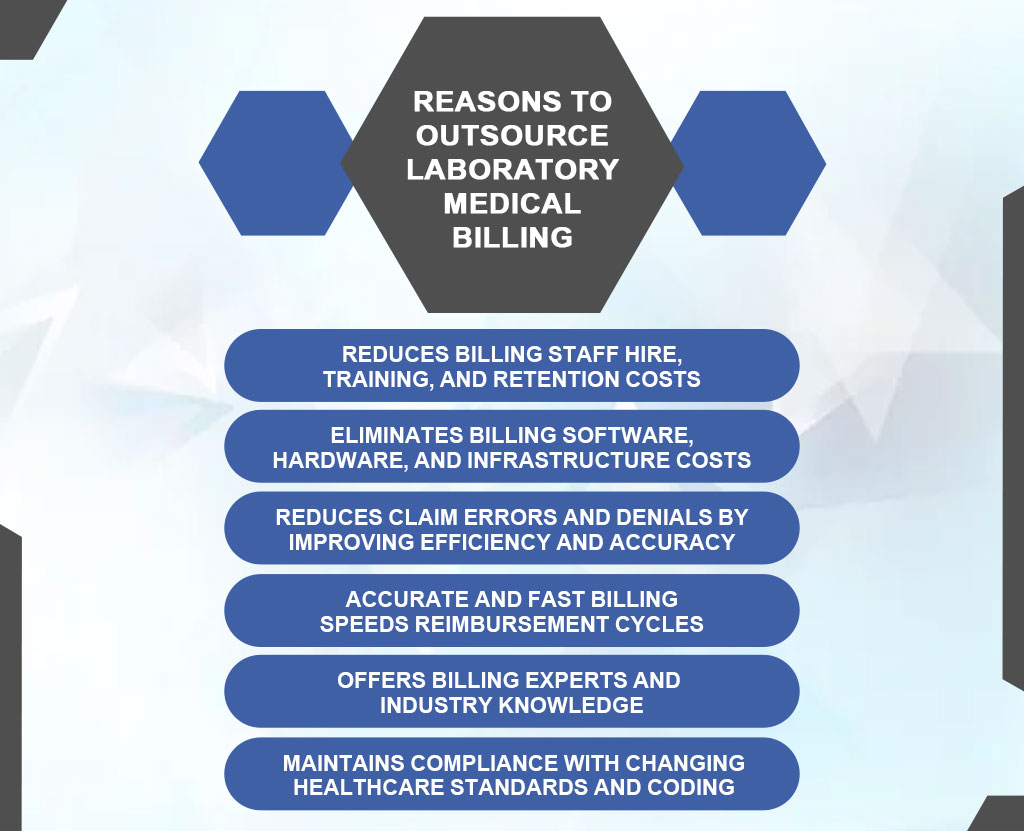
- Reduces billing staff hiring, training, and retention costs.
- Eliminates billing software, hardware, and infrastructure costs.
- Reduces claim errors and denials by improving efficiency and accuracy.
- Accurate and fast billing speeds reimbursement cycles.
- Offers billing experts and industry knowledge.
- Maintains compliance with changing healthcare standards and coding.
Benefits of Outsourcing Laboratory Medical Billing
- Expert medical billing and coding firms ensure accuracy and eliminate errors.
- Streamlined processes speed up claim submissions and payments.
- Using less in-house billing staff reduces administrative costs.
- Reduces training, software, and infrastructure costs.
- Professional billing services maximize revenue cycle management, increasing cash flow.
- Laboratories can focus on quality diagnostics.
- Reduces laboratory staff administrative strain, letting them focus on patient care and other important responsibilities.
- Modern billing software and technologies boost efficiency and accuracy.
- Data-driven insights aid strategic planning and decision-making.
- Correct billing statements promote patient understanding and transparency.
- Enjoy the expertise and experience of laboratory billing specialists.
Tips For Finding Laboratory Medical Billing Companies Near Me
Research and Referrals
First, ask other healthcare providers or laboratories you work closely with. Recommendations from close friends and relatives may assist in determining the quality and reliability of the local billing companies.
Local Business Directories
Conduct a search on popular online business directories like Yelp, Yellow Pages, or Google My Business to locate lab billing companies in your region. Such platforms often contain comments and scores from other clients who have used the particular services before.
Professional Associations
Consult with Your Local Chamber of Commerce
Chambers of commerce in your locality have details of your region’s recognized laboratory billing companies.
Attend Local Healthcare Events and Conferences
Attend regional healthcare fairs, exhibitions, and forums where consumers of billing services can be met and explored on the spot.
Hire an Expert Lab Billing Company
Laboratory managers often have limited time and staff resources to manage a demanding billing process on top of operational responsibilities. Outsourcing can make that process more manageable by reducing billing friction and improving collections.
A strong laboratory billing company should improve more than just claim submission. It should also support compliance, reduce denials, provide clearer reporting, and help the lab stay focused on testing quality rather than administrative cleanup.
Conclusion
Outsourcing laboratory medical billing can help laboratories improve accuracy, reduce denials, strengthen compliance, and support healthier cash flow. For labs dealing with growing claim volume or internal billing strain, outsourcing can be a practical step toward more efficient revenue cycle management.