

Postoperative visits often require evaluation and management (E&M) services in addition to postoperative care. Determining the E&M service level for each component of the visit and assigning that component to the appropriate payment (i.e. surgery payment or new payment) is the challenge.
Modifier 24 describes a post-operative E&M service that is eligible to support a separate payment and is performed by the same physician or qualified health care professional. However, its application is based on the service, relationship of the individual to the beneficiary, active global period, and other reasons, including the presence of other conditions.
In the case of the surgical payment, the documentation must be complete and precise; otherwise, the payment may be denied and the service billed as an error.
Start With the Reason for Today’s Visit
Before checking modifiers, read the assessment and plan. Identify the problem the clinician actually evaluated and managed.
Most postoperative encounters fall into one of three situations:
- Recovery care only: The clinician checks healing, addresses expected symptoms, or adjusts routine postoperative instructions.
- Unrelated care only: The patient needs evaluation of a condition independent of the operation and its recovery.
- Both during one appointment: Routine aftercare occurs alongside a separately supported evaluation of another condition.
The third situation deserves particular attention. An appointment does not become entirely billable because one unrelated problem was addressed. Only the qualifying separate work can support the additional E/M service.
Likewise, a problem mentioned casually during a wound check does not automatically create another service. The note needs to show an actual evaluation and management plan.
Practical question: If you removed the routine postoperative work from this record, would a medically necessary E/M still be supported?
That question helps identify the work worth reviewing. It does not replace the remaining eligibility checks.
Three Conditions That Must Line Up
Once the separate work is clear, confirm timing, provider responsibility, and clinical independence. Modifier 24 usage becomes much easier when these questions are answered in that order.
The postoperative period is still active
Check the original procedure code and surgery date. Use the actual global-period assignment for the payer and date of service.
Do not estimate from the procedure’s name or how extensive it sounded. Two procedures described informally as “minor” can have different postoperative periods.
| Global indicator | How the period works |
| 000 | The procedure date is included, with no postoperative days afterward |
| 010 | The surgery date and the following ten days are included |
| 090 | The day before surgery, surgery date, and following ninety days are included |
| XXX | The surgical global-period concept does not apply |
| YYY | The applicable contractor determines the global period |
| ZZZ | The add-on service follows the relevant primary procedure’s global period |
Suppose a procedure with a ten-day postoperative period takes place October 4. The postoperative days run through October 14. A visit on October 15 no longer needs modifier 24 for that procedure’s package.
Payment still depends on the service meeting other requirements. An expired global period does not make an unsupported visit payable.
If the patient has undergone several operations, check each relevant period. A shoulder evaluation might be unrelated to an earlier hand operation but directly related to another recent shoulder procedure.
The clinician falls within the relevant surgical arrangement
According to Medicare’s global surgery rules, when members of a practice belong to the same specialty, they are considered a single physician for billing purposes.
Therefore, a surgical partner would need to append modifier 24 to bill for services that are unrelated and occur within the same surgical procedure. Likewise, a surgical partner covering the surgeon’s post-op appointments would be considered rending for recovery and would therefore be included.
Another specialty or independent practice would require further evaluation. It would not be appropriate to append modifier 24 to a post op visit if the patient had their surgery at another facility.
For post-operative care to be formally transferred to another practice, the receiving physician would be allowed to bill for related services and assessments, including evaluation and management services, and append modifier 24.
Practice policy states that nurse Practitioners and Physician Assistants should also adhere to these principles.
The evaluation falls outside surgical recovery
The relationship between diagnoses is more important than how they are labeled.
An example is a post-operative infection, which is a separate diagnosis from the operation, but is related to the surgery. Management of a pre-existing condition may require different interventions, but is in no way related to the surgery.
How the clinician perceives the relationship is the most important factor. Coders should not make assumptions about the relationship between diagnoses based on how the diagnoses are named, where the symptoms are located, or if the symptoms warrant a separate payment.
A New Diagnosis Does Not Always Mean a Separate Service
Several shortcuts cause trouble with modifier 24 guidelines.
“It started after surgery, so it must be unrelated.” New symptoms may represent a complication, a medication effect, or another consequence of recovery.
“It involves another body part.” A complaint in another location could still be connected to surgical positioning, altered movement, or assistive-device use.
“The diagnosis is the same, so nothing can be billed.” Management of an underlying disease or an additional treatment course may fall outside routine recovery. Similar diagnosis coding calls for careful review, not an automatic conclusion.
“The note says unrelated.” That statement needs clinical support. A label cannot override documentation describing complication management.
Keep diagnosis selection accurate. If the documented condition does not support separate reporting, searching for a different code will not fix the underlying issue.
Six Encounters That Show Where the Line Falls
The following examples illustrate coding decisions rather than complete medical records. Any E/M level must meet its own requirements before a modifier is added.
1. A separate injury during orthopedic recovery
A patient sees the operating surgeon during a verified ninety-day hip-surgery period. The visit also includes evaluation of elbow pain after an independent injury.
The surgeon records elbow findings, an assessment, and a treatment plan that are separate from hip recovery.
Coding approach: Modifier 24 may apply to the elbow E/M. If that work independently meets the requirements for 99213, the claim could include 99213-24.
The routine hip examination remains within the surgical package. Its time and complexity cannot be used to raise the level of the elbow evaluation.
2. An incision problem requiring extra attention
A patient returns with redness and drainage at the operative site. The surgeon evaluates the complication and changes treatment without a qualifying return to the operating room.
Coding approach: This is related postoperative management, so modifier 24 does not fit the Medicare E/M claim.
The amount of effort does not change the relationship. A complicated visit can remain included. If a return procedure is required, evaluate the procedure’s reporting separately rather than calling the complication unrelated.
3. An existing skin condition needs treatment
During recovery from an excision with a verified ten-day period, a patient requests care for worsening acne. The dermatologist evaluates the condition and revises its treatment independently of the excision follow-up.
Coding approach: A supported acne E/M may qualify for modifier 24. The condition does not need to be newly diagnosed, and both services involving skin does not automatically make them related.
An acne diagnosis copied into the encounter without evaluation would not support the same billing decision.
4. Pathology leads to a treatment discussion
A discussion regarding a new malignant diagnosis is part of a post-operative visit. This discussion is split into two parts. The first part discusses the new diagnosis with the patient. The second part considers other aspects of management, including planning for post-operative treatment and recovery.
Coding management: A separate E/M service for the discussion of a new malignant diagnosis can be reported in addition to the surgical procedure. Modifier 24 should not be automatically assigned in all situations.
Because the cancer may have been present prior to surgery, and may affect the billability of the surgical procedure, judgement should be exercised before assigning modifier 59 to the E/M service.
5. The patient has another procedure that day
A surgeon evaluates an unrelated condition during an earlier operation’s global period and performs a new minor procedure. The evaluation includes significant work beyond the assessment ordinarily included in that procedure.
Coding approach: The qualifying E/M may require both 24 and 25. The new procedure needs its own modifier analysis.
If the patient arrived for a previously planned procedure and received only its usual assessment, there may be no separately reportable E/M at all.
6. The appointment is still labeled postoperative
A patient returns after the verified ten-day period has ended. No other relevant global period is active, and the clinician performs a supported E/M.
Coding approach: Do not carry modifier 24 forward just because the appointment type says “post-op.” Report the actual service under the requirements that apply on that date.
Choose the Modifier for Each Service Line
Modifier 24, modifier 25, and modifier 79 solve different reporting questions. Confusion usually starts when one is treated as a substitute for another.
| Modifier | Question it answers | Where it belongs |
| 24 | Is this E/M unrelated to the earlier surgery during its postoperative period? | Eligible E/M line |
| 25 | Is today’s E/M significant and separately identifiable from another same-day procedure or service? | Eligible E/M line |
| 79 | Is this procedure unrelated to the earlier operation during its postoperative period? | Applicable procedure line |
Using 24 and 25 Together
Both must be used together to describe the same E/M level when a specific evaluation is performed that is unrelated to the previous surgery and exceeds the standard surgery-related E/M activity for the day.
An example is using cpt code 99213 with modifiers 24 and 25, if independent medical record documentation supports the level and the requirements of both modifiers 24 and 25. Code the level supported by the payer.
Using modifier 25 on the procedure code in this circumstance is incorrect. Both E/M modifiers are to be assigned on the E/M level being reported.
Also, a different diagnosis is not justified with use of modifier 25. An E/M service is defined as medically necessary, including the E/M service that supports and/or justifies the performance of a minor procedure.
Dealing with the original surgery date
A same-day E/M service for surgery typically requires an analysis regarding modifier 25 or 57.
just because a procedure happens on a given day, doesn’t mean modifier 24 can’t be applied on that same day. It’s possible to perform a procedure on a given day that would be considered part of the post-operative period for a previous surgery.
Separating tests from interpretations
Copying modifier 24 to any associated lab, x-ray or procedure code will not be reimbursed. Only the service actually rendered will be accepted.
Interpreting a diagnostic study with modifier 26 may be considered an professional interpretation service. Performing the study or test will not convert the service to an E/M service.
Know When Another Modifier Deserves Attention
Some postoperative services require a different approach even when they are separately reportable.
Modifier 57: For Medicare, the initial decision for major surgery generally falls on the day before or day of surgery when this modifier is needed. If that evaluation is unrelated to another operation whose global period remains active, 24 and 57 may both apply. A routine preoperative appointment after the decision was made is different.
Modifier 58: Review this for an applicable planned stage, more extensive procedure, or therapy following diagnostic surgery. Related does not necessarily mean nonbillable. A pathology finding alone should not push a subsequent procedure into modifier 79.
Modifier 78: Consider this for a qualifying unplanned return to the operating or procedure room for a related procedure. It does not justify reclassifying the related complication E/M as unrelated.
Modifier FT: Medicare uses FT for qualifying unrelated critical care during the global period. Codes 99291 and 99292 require their own clinical and time support. Being treated in an ICU does not establish critical care by itself.
Inpatient encounters also need closer review. Medicare limits modifier 24 use before discharge, with specified exceptions involving transplant immunotherapy management and unrelated subsequent hospitalization. An office-based example should not be applied automatically during the original surgical admission.
Write the Note in a Way That Separates the Work
The record should be complete enough that another reviewer can follow the clinical rationale and determine that service was necessary.
Provide the indication for the evaluation, and any related historical and examining findings. State the patient’s condition and the intervention. Describe the relationship of the condition and the intervention to the recent surgery.
If the evaluation involves addressing an independent problem and addressing the recovery of the surgery, the recovery assessment should be documented separately from the other. This provides the coder with the reason and support for the E/M level selected, and avoids double counting the aftercare.
Replace conclusions with clinical context
“Unrelated problem; bill modifier 24” is a billing instruction, not adequate clinical support.
A more useful explanation would identify the independent event or condition: “Elbow symptoms began after a separate injury. The elbow assessment and treatment plan are documented independently of today’s routine hip recovery check.”
Use that wording only when it reflects the encounter. The complete note still needs the actual examination findings, assessment, and decisions made.
Ask neutral questions when a relationship is unclear
Let’s say the chart states that a patient has a rash and recently used post-op medication, and the chart does not state whether there is a relationship between the two.
Ask the clinician to clarify the relationship, if any, and indicate if the relationship is “undetermined.” Ask for an “unrelated” diagnosis to allow the practice to bill a visit, only if necessary.
Templates should be neutral. Any changes to the template should be completed in accordance with the practice’s policies, and only if care was provided that is consistent with the changes.
E/M Level Before Adding Modifier 24
Modifier 24 does not adjust for service complexity. Adjust the level as appropriate based on the category of service, the patient’s condition at the time of the service, and the current medical decision making or qualifying time.
Performing a simple evaluation during the post-operative recovery period from a major surgery does not warrant a level 4 or 5 service. The level of complexity of the surgery being recovered from does not warrant a level 4 or 5 service.
A long appointment may include time for multiple unrelated services. Each service must meet the requirements of an E/M service.
Prior to releasing a claim, compare the surgical diagnosis to the other diagnoses documented to determine if the software captured the correct diagnosis and inadvertently carried the surgical diagnosis forward.
Ensure the codes selected accurately reflect the conditions of the patient, the symptoms of the patient, and the findings of the date of service. Code selection should be specific and lateral.
Resolve Modifier 24 Denials Without Guessing
A denied postoperative claim needs a cause-specific response. Adding another modifier or resubmitting the same claim can create more work without addressing the problem.
| Issue found during review | Appropriate next step |
| Modifier missing from the transmitted claim | Investigate charge-entry or transmission errors and correct the claim as appropriate |
| Visit classified as routine recovery | Compare the signed note with the payer’s bundling explanation |
| Diagnosis pointer does not match the E/M | Correct the supported service-line linkage |
| Global-period dates differ | Reconcile the original procedure, service dates, and overlapping operations |
| Provider relationship is unclear | Verify specialty, group, rendering information, and any transfer arrangement |
| Documentation request remains unresolved | Submit the requested records through the designated route before the deadline |
| Eligibility, authorization, or filing issue | Resolve that requirement directly rather than treating it as a modifier error |
CARC 24 and CPT modifier 24 belong to different code systems. CARC 24 concerns capitation or managed-care coverage of charges. Seeing that adjustment code does not mean the payer is asking for postoperative modifier documentation.
Analyze the appeal to respond to the denial
What will the next step in the process be, a corrected claim, reconsideration, appeal, or request for records? Assign a team member, and enter the case management deadline.
Provide the claim ID, denial ID, date of prior request, and signed E/M record. State the reason for requesting the review, and provide the assessment and rationale to support the request.
Be clear and direct. If there is a dispute about the date, provide evidence to support your position. If records were not requested or reviewed, provide the records. Explaining that modifier 24 was appropriate will not change the outcome for a request for review of the same records.
Retain the submission acknowledgement and explain the rationale for the position. A service that is recovery care will not be appealed as unrelated simply because a request for review of the service was completed.
Avoid Duplicating Processing Errors Due to Payers Differences
There are differences in processes, edits and requirements for completing various insurance forms among various payers. It is important to determine the specific payer coverage for the patient to ensure the processes and edits are followed correctly.
Be mindful of the current instructions for plan and claim processing, as well as requests and appeals. Inconsistencies in instructions should not be universalized to the practice.
Eligibility for telehealth services is determined separately. Evaluations, even if not done in-person, still require correct code, coverage level, place of service and appropriate modifiers.
Hospital based professionals should not assume that if a given claim is paid, the service was appropriately provided. Hospital based professionals also should not assume payment for facility based services.
For quality improvement (QI) purposes, samples of either documented or observed services may be reviewed, including claim denials and payments. Review of samples may include validation of modifier use and/or reasons for coding level.
Issues reviewed by the practice should include paid claims, modifier 24, billing for evaluation and management services for post-operative visits, and/or incorrect global period claims.
Give each handoff a clear purpose
The front desk can flag a recent operation and capture why the patient requested the appointment. That flag should send the encounter for review, not automatically assign a modifier.
The clinician establishes the clinical facts. The coder then evaluates the service, global period, and provider relationship. Billing staff confirm that the submitted claim preserves the intended codes and diagnosis pointers.
When the follow-up team receives a denial, its notes should identify the issue, next action, responsible person, and deadline. “Follow up with insurance” leaves too much unanswered for the next person opening the account.
A useful internal note might read: “Payer bundled the E/M into the earlier operation. Modifier transmitted correctly. Signed note supports separate injury evaluation. Appeal packet pending coding review; assigned to the designated reviewer before the filing deadline.”
Use this level of detail when it reflects the claim. The objective is to prevent another staff member from repeating the entire investigation.
Address the Source of the Problem
If a particular incorrect global date occurs repeatedly, the source of the error is likely in the procedure record or the way the system performs the calculation. Denials will continue unless the error in the system is corrected.
If a consistent pattern emerges in which the same providers document an unmanaged second diagnosis, this may reflect deficiencies in the clinical prompts. If a modifier disappears during the claim-editing process, the editing software may not be properly mapped to the document being edited. The editing software should not be used to revise clinical documentation.
It is the responsibility of the organization to validate that processes have been improved. It is also the responsibility of the organization to investigate why the denial rate has decreased.
It is also the responsibility of the organization to ensure that processes and services added to support coding remain valid.
Common Questions From Billers and Coders
Can modifier 24 be used for a chronic condition?
Yes, when the clinician performs a qualifying E/M for a chronic condition unrelated to the surgical recovery and the other requirements are satisfied. The condition must be assessed and managed, not merely listed in the history.
Does modifier 24 always need a different diagnosis?
No universal diagnosis-only shortcut settles the decision. The documented service must fall outside the relevant package. Different codes can describe related complications, while some underlying-disease management requires closer review despite diagnosis overlap. Apply the payer’s requirements without altering an accurate diagnosis.
Can another surgeon in the group report modifier 24?
Yes, when supported. Medicare generally treats same-group, same-specialty physicians as one physician for global billing. A covering partner’s unrelated E/M may qualify, while ordinary postoperative care remains included.
Can I use modifiers 24 and 25 together?
Yes, if the E/M is unrelated to an earlier surgery and significant and separately identifiable from today’s procedure. Both belong on the qualifying E/M line. A separate procedure alone does not establish a billable E/M.
Does modifier 24 guarantee separate payment?
No. It explains the E/M’s relationship to the surgical package. Medical necessity, coverage, documentation, provider information, and other claim requirements still apply. A denial should be reviewed for its actual cause before the claim is changed.
A Final Check Before the Claim Leaves Your Queue
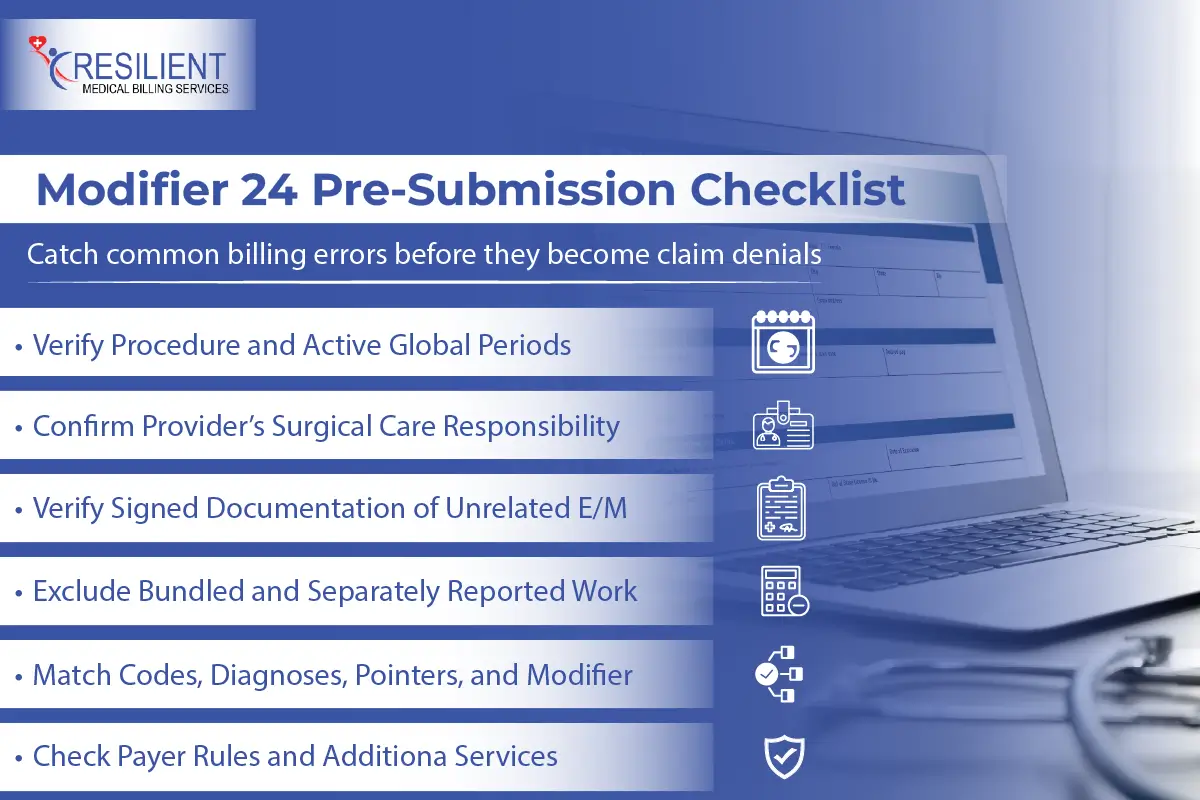
Use this review before submitting an unrelated postoperative E/M:
- Confirm the timeline: Verify the procedure and every relevant active global period.
- Confirm the provider: Establish the clinician’s responsibility within the surgical arrangement.
- Confirm the work: Identify the independent assessment and management in the signed record.
- Confirm the level: Exclude routine recovery care and other separately reported work.
- Confirm each line: Match codes, diagnoses, pointers, and modifiers to the service furnished.
- Confirm the payer requirements: Check submission details, documentation, and any additional services.
Resolve an unclear item before releasing the claim. For recurring postoperative billing problems, Resilient MBS can help review coding, claims, and denial workflows so your team addresses the cause instead of repeatedly correcting the same error.




