Covering all elements for a CPT code 99205 take time, but often, that is where the process ends. There are also questions relating to the nature of the medical decision making. Was the level of detail and complexity in the element of the visit sufficiently high? Then there is the question relating to time. Did the physician or qualified health care professional spend 60 or more minutes on the date of the service?
Describing elements of a service to support a code and then not adequately documenting the rationale and reasoning behind the assignment leads to reimbursement issues. Often, the time element is identified and supported. But MDM may also be adequately described and tied to the service.
Our objective is to encompass the rationale behind the assigned code. Reasoning may be difficult, but conveying rationale to support a assigned code to others should be easier.
Assess Patient’s Situation Before Determining Complexity Level
The highest-level evaluation and management code for new patients in the ambulatory setting is 99205. Once you’ve assessed a patient is appropriate for a new patient level of service, consider the appropriate level of classification based on complexity.
When determining if a patient is a new patient or a returning patient, consider if the patient has received a service by the same physician or qualified health care professional (or by a clinician in the same specialty or subspecialty) within the last three years. If the patient has, then the patient is considered to be returning.
A first visit with an individual clinician is not always a new-patient encounter.
For example:
- Different clinician, same specialty and group: A patient seen by another internist in the group 18 months earlier is generally established.
- Same clinician, different practice: Moving to a new office does not erase the clinician’s previous relationship with the patient.
- Different specialty within one group: The patient may qualify as new, depending on the specialty relationship and payer rules.
- New diagnosis or new insurance: Neither change automatically creates new-patient status.
Check records across practice locations. When subspecialty recognition is uncertain, verify the payer’s classification instead of relying solely on a different taxonomy code.
Also confirm the service type. A routine preventive examination does not become a problem-oriented 99205 encounter simply because the patient is new.
Two Ways to Support 99205, With Different Evidence
The code can be selected using high-level MDM or total qualifying time. Both routes require a medically appropriate history and/or examination, but counting history or examination elements does not establish the visit level.
| Selection method | Evidence supporting 99205 |
|---|---|
| Medical decision making | At least two of the three MDM elements meet the high level |
| Total time | At least 60 qualifying physician or QHP minutes on the encounter date |
These methods operate independently.
A clinician who completes a high-MDM encounter in 38 minutes may code 99205 based on MDM. However, if total time spent in the encounter is 60 minutes, and MDM is moderate, the code may also be supportable.
Generally, length of the encounter or the documentation are not determining factors for the level of the code. If medical necessity is supported by other factors, a higher level code may be appropriate.
Follow the Clinical Decisions Through the MDM Record
The three MDM elements assess the problems addressed, the data reviewed and analyzed, and the risk of patient management. At least two must reach the high level to support 99205 through MDM.
A Serious Problem Must Be Addressed During the Encounter
The problems element reaches the high level for conditions such as:
- A chronic illness with severe exacerbation, progression, or treatment side effects.
- An acute or chronic illness or injury threatening life or bodily function.
The diagnosis name alone rarely explains enough. The record should describe the condition’s severity, its clinical implications, and the evaluation or management performed.
An inactive diagnosis carried forward from an earlier note should not inflate the encounter’s complexity. Similarly, several stable chronic illnesses do not automatically equal one high-level problem.
Useful documentation answers a practical question: How did this condition affect the provider’s work and decisions during this visit?
Extensive Data Has Its Own Two-of-Three Test
The data element contains three categories. Reaching high-level data requires meeting at least two categories.
| Data category | Work to evaluate |
|---|---|
| Tests, documents, orders and independent historian | A qualifying combination of at least three items under the data-counting rules |
| Independent interpretation | Interpretation of a test performed by another physician or QHP, when not separately reported |
| External discussion | Discussion of management or test interpretation with an external physician, QHP or appropriate source, when not separately reported |
Do not individually count every value or entry on a page. Additionally, specific counting rules are included with specialized tests and external services. Repeating the same test or order does not warrant multiple counts.
A referral order does not document an external peer discussion. For there to be an external peer discussion, the documentation must describe an exchange regarding test interpretation or management.
In regards to special counts, the description of external test results and notes may warrant a count. Documentation of management discussion with an external individual may also be appropriate. A statement of “extensive record review” does not provide enough information and does not warrant special counts.
High Risk Requires More Than a New Prescription
The risk element concerns the risk associated with patient management. Examples that may support high risk include:
- A decision regarding hospitalization or escalation of hospital-level care.
- Emergency major surgery.
- Elective major surgery with identified patient or procedure risk factors.
- Drug therapy requiring intensive monitoring for toxicity.
- A decision to forgo resuscitation or de-escalate care because of poor prognosis.
Standard drug management is considered moderate risk. Adding laboratory testing does not increase risk to the level of high risk.
To demonstrate intensive monitoring for the purposes of risk adjustment, the documentation should define the adverse effect being monitored, the type of monitoring, and how the management affects the adverse effect. Monitoring the effect of a medication, for example, salicylate level monitoring, does not always define the level of intensive monitoring for toxicity.
Risk adjustment may be accomplished with a single high-risk management decision. However, the encounter also requires a second high-level MDM element to qualify for 99205 through MDM.
Count Clinical Time Without Counting It Twice
The 99205 code requires that 60 minutes of qualifying work be performed on the encounter day by the physician or other qualified healthcare practitioner (QHP).
This 60 minutes can include work performed before or after the face-to-face portion of the service. However, this 60 minutes should reflect the total time spent on the qualifying activity for that encounter and not the time allotted for the activity.
Activities that may count include:
- Reviewing relevant records and test results.
- Obtaining or reviewing separately collected history.
- Evaluating and examining the patient.
- Counseling the patient, family or caregiver.
- Ordering medications, tests or procedures.
- Communicating with other professionals about care.
- Documenting clinical information.
- Independently interpreting results and communicating findings when not separately reported.
Exclude clinical staff time, patient waiting time, travel, unrelated teaching, and time assigned to separately reported services. Record review performed on another calendar date does not count toward this encounter’s time threshold.
A Time Example That Shows the Difference
Consider a new patient whose physician spends:
- 12 minutes reviewing relevant records before the appointment.
- 36 minutes evaluating and counseling the patient.
- 7 minutes arranging care and placing orders.
- 9 minutes completing clinical documentation.
The total is 64 minutes. If all activities qualify, occur on the encounter date, and exclude separately reported services, time may support 99205.
The nurse’s rooming time cannot be added. Neither can time spent waiting for records to arrive.
Record a Definite Total
A useful time statement might read:
I personally spent 64 minutes on this encounter on the date of service, including record review, evaluation, counseling, treatment planning, care coordination and documentation. The total excludes separately reported services.
A minute-by-minute account isn’t always necessary when providing an activity breakdown. As long as the essence of the participant’s documentation is captured, you may provide a broad stroke account.
An “extended appointment” does not establish a time threshold for an extended encounter. An automatically populated appointment duration (based on the type of appointment) also does not establish a time threshold.
There is no time threshold for the use of the Office/Outpatient code that indicates that counseling/psychotherapy occupied more than 50% of the total time.
The 99204–99205 Boundary in Everyday Coding
Both codes apply to new patients. The meaningful difference is the documented MDM level or qualifying total time.
| Code | MDM level | Minimum time when selecting by time |
|---|---|---|
| 99202 | Straightforward | 15 minutes |
| 99203 | Low | 30 minutes |
| 99204 | Moderate | 45 minutes |
| 99205 | High | 60 minutes |
The time column applies only when time determines the level. It is not an additional requirement for MDM-based selection.
Scenario: One High Element, Two Moderate Elements
Clinical access occurs for an accelerating condition. Two of the elements score high, one scores moderate for each of data and management risk.
The overall MDM supports a code level 99204, as two elements score moderate rather than high. If the total qualifying time is 52 minutes, time supports this code level as well.
Scenario: Moderate MDM, Sufficient Time
A new patient required extended counseling, review of relevant records, and planning for treatment. The MDM continues to be moderate, but the total qualified clinical time was 68 minutes.
The counseling may be supported 99205, based on time, if work completed and the total time are documented in the progress note.
Scenario: High MDM During a Shorter Encounter
A clinician has determined that one of their new patients has a condition which is potentially life threatening. Based on this determination, the clinician has decided that hospital level care is appropriate. In this situation, if both the elements of risk and the nature of the problems being evaluated determine that they are of a high level, the element of time may be disregarded, and 99205 might be assigned, even if the visit lasted less than 60 minutes.
These are illustrative examples of coding practices. The assignment of a code is determined by a review of the entire record, the setting in which the service was performed, and applicable guidelines.
Build a Note That Explains the Work
The strongest 99205 documentation lets another professional follow the clinical reasoning without searching through copied material.
A clear record should identify:
- The reason for the encounter.
- Relevant history and examination findings.
- Conditions actively evaluated or managed.
- Data reviewed, ordered, interpreted or discussed.
- Treatment decisions and their rationale.
- Follow-up instructions and contingency plans.
- Total qualifying time when time determines the level.
Using specific phrases can be useful, but using prescribed phrases does not increase complexity. Saying “threat to a bodily function” without supporting information is as weak as selecting “high MDM.”
Selecting both “high MDM” and a qualifying time also can be reported. A short time period does not preclude a high level of MDM and a moderate level of MDM does not preclude a time-based element of 99205.
Make sure your codes match your diagnoses
No diagnosis codes exist to represent “new patient.”
In order to justify services rendered, you must provide supporting documentation for any diagnoses, symptoms, or reasons for the patient visit. Do not add unnecessary diagnoses to make your claim morecomplicated. Do not use a routine examination diagnosis to represent a problem-oriented visit, unless the visit was in fact a routine examination.
Longer Visits Need a Separate Prolonged-Service Check
Reaching 60 minutes supports the base code when time is the selection method. Additional time may support prolonged-service reporting, but the add-on code and threshold depend on the payer.
Original Medicare uses G2212 for qualifying prolonged office/outpatient services. A payer following CPT prolonged-service rules may accept 99417. Commercial plans do not all apply identical policies.
Before adding prolonged services, confirm:
- The base E/M code was selected using time.
- The payer recognizes the proposed add-on.
- The applicable threshold and full additional increments are met.
- The total excludes separately reported work.
Do not attach an office prolonged-service add-on to 99204 simply because that encounter lasted longer than expected. Review the appropriate base code and the payer’s complete reporting rules.
When a 99205 Claim Gets Denied or Reduced
Start with the remittance explanation. A registration error, a bundling edit and a medical-necessity denial require different responses.
| Problem | Review before correcting or appealing |
|---|---|
| Patient classified as established | Prior services, clinician identity, specialty and group relationship |
| Level unsupported | Two-of-three MDM analysis or qualifying documented time |
| Time insufficient | Actual clinician minutes, same-date work and excluded services |
| E/M bundled with a procedure | Whether a significant, separately identifiable E/M service occurred |
| Coverage or enrollment issue | Benefits, network status, referral requirements and rendering-provider details |
For an appeal, connect the documentation to the disputed criterion. If the payer questioned high MDM, identify the two qualifying elements. If the claim was time-based, point to the documented total and work performed.
Avoid resubmitting an unchanged claim without addressing the denial reason. Do not reconstruct undocumented work simply to reach a higher code.
Use Modifier 25 Correctly
A same-day procedure does not warrant modifier 25. The E/M service must be considerable and individualized above the ordinary service associated with the procedure.
Separate diagnoses are not necessarily required. Likewise, the assignment of different diagnosis codes does not show that two different services were rendered.
Set Your Reimbursement Expectations Based on the Contract
A specific dollar amount for CPT code 99205 does not exist.
Variability in Medicare reimbursement may be due to geographic adjustments, the setting (facility vs. non-facility), the type of clinician, and various adjustments at the claim level. Other payers (i.e. private insurance) reimburse based on their contracted rates and the plan’s benefits and policies.
Understand what the payer will reimburse and consider patient responsibility and any other adjustments. The reimbursement amount may not fully cover the allowed amount.
Verify the plan covers telehealth, the modality, the place of service, and correct modifier(s). Also, verify the same for NP and PA services and ensure correct enrollment and billing.
FAQs From the Coding Desk
Can I bill 99205 for a 45-minute appointment?
Yes, if high MDM supports the code. A 45-minute scheduled appointment may also involve additional qualifying clinician work on the encounter date, but only actual documented time counts toward time-based selection.
Does 99205 require both high MDM and 60 minutes?
No. Either high MDM or at least 60 qualifying minutes may support the code. The record must support the method used.
Can three stable chronic conditions justify 99205?
Not automatically. Evaluate the problems addressed, data and management risk. Diagnosis count alone does not establish high MDM, although qualifying total time may independently support the code.
Can chart review before the appointment count?
Yes, when it is qualifying physician or QHP work performed on the encounter date. Review performed the day before does not count toward that visit’s total time.
Does 99205 need a modifier on every claim?
No. A modifier depends on the services, setting and payer requirements. Select it because the documented circumstances meet its definition.
Does a denied 99205 have to be changed to 99204?
No. Determine whether the original code was supported and why payment was denied. Appeal a supported claim when appropriate; correct the code when the record supports a different level.
Before You Release the Claim
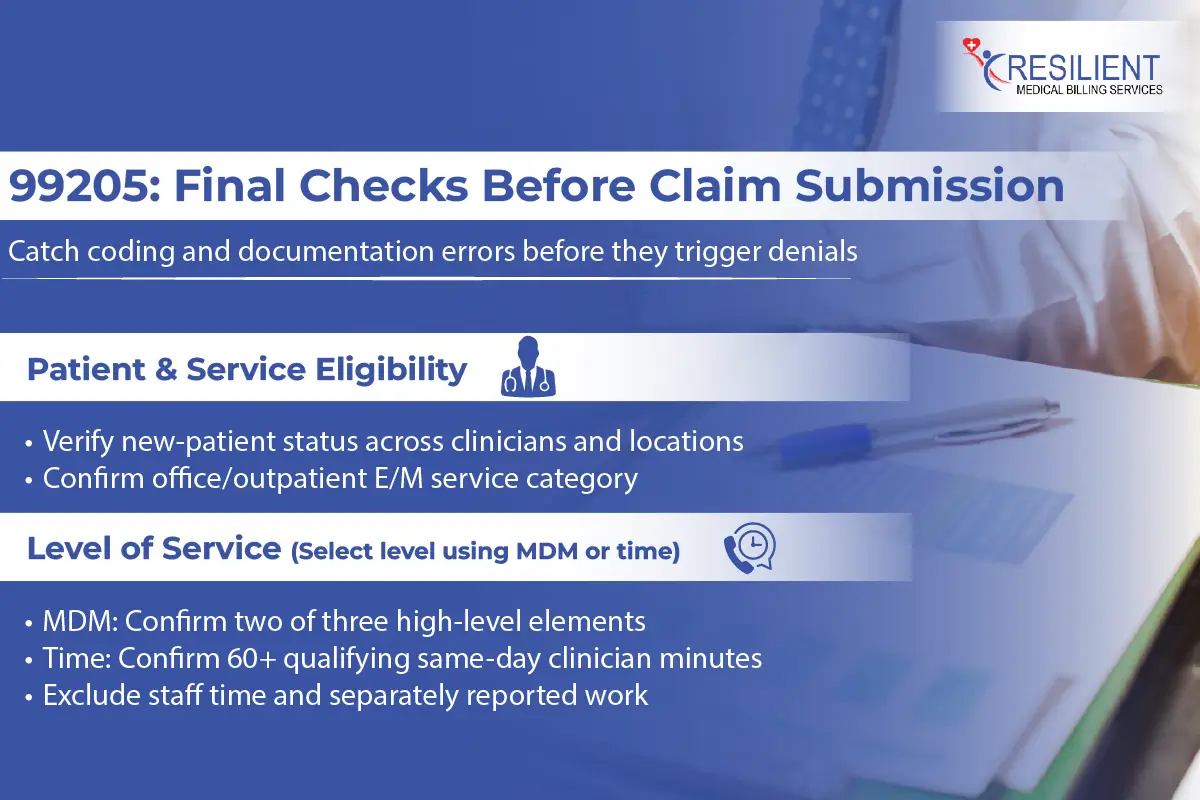
Use this final check to catch the errors that matter:
- Confirm new-patient status across the relevant clinicians and practice locations.
- Verify that the service belongs in the office/outpatient E/M category.
- Identify whether MDM or time supports the selected level.
- For MDM, confirm two high-level elements.
- For time, confirm at least 60 qualifying clinician minutes on the encounter date.
- Exclude staff time and separately reported work.
- Check that diagnoses reflect the conditions and reasons addressed.
- Support any modifier or prolonged-service add-on.
- Resolve payer-specific coverage, referral and enrollment requirements.
- Make sure the assessment and plan explain the service actually provided.